EXERCISE 7.1
Coordinate Geometry • 10 Questions
Question 1
Hint available
Find the distance between the following pairs of points : (i) (2, 3), (4, 1) (ii) (– 5, 7), (– 1, 3) (iii) (a, b), (– a, – b)
Key Idea
Use the distance formula in the Cartesian plane, which is obtained from the Pythagorean theorem: for points \((x_1,y_1)\) and \((x_2,y_2)\), the distance \(d\) is \[ d = \sqrt{(x_2-x_1)^2 + (y_2-y_1)^2}. \]
Step-by-Step Solution
1. Recall the distance formula
\[ d = \sqrt{(x_2-x_1)^2 + (y_2-y_1)^2} \]
2. Case (i): Points \((2,3)\) and \((4,1)\)
\[ \begin{aligned}
d_{1} &= \sqrt{(4-2)^2 + (1-3)^2} \\
&= \sqrt{2^2 + (-2)^2} \\
&= \sqrt{4+4} \\
&= \sqrt{8} \\
&= 2\sqrt{2}.
\end{aligned} \]
3. Case (ii): Points \((-5,7)\) and \((-1,3)\)
\[ \begin{aligned}
d_{2} &= \sqrt{(-1-(-5))^2 + (3-7)^2} \\
&= \sqrt{4^2 + (-4)^2} \\
&= \sqrt{16+16} \\
&= \sqrt{32} \\
&= 4\sqrt{2}.
\end{aligned} \]
4. Case (iii): Points \((a,b)\) and \((-a,-b)\)
\[ \begin{aligned}
d_{3} &= \sqrt{(-a-a)^2 + (-b-b)^2} \\
&= \sqrt{(-2a)^2 + (-2b)^2} \\
&= \sqrt{4a^2 + 4b^2} \\
&= 2\sqrt{a^2 + b^2}.
\end{aligned} \]
5. Write the final answers
- (i) \(d = 2\sqrt{2}\) units
- (ii) \(d = 4\sqrt{2}\) units
- (iii) \(d = 2\sqrt{a^{2}+b^{2}}\) units
\[ d = \sqrt{(x_2-x_1)^2 + (y_2-y_1)^2} \]
2. Case (i): Points \((2,3)\) and \((4,1)\)
\[ \begin{aligned}
d_{1} &= \sqrt{(4-2)^2 + (1-3)^2} \\
&= \sqrt{2^2 + (-2)^2} \\
&= \sqrt{4+4} \\
&= \sqrt{8} \\
&= 2\sqrt{2}.
\end{aligned} \]
3. Case (ii): Points \((-5,7)\) and \((-1,3)\)
\[ \begin{aligned}
d_{2} &= \sqrt{(-1-(-5))^2 + (3-7)^2} \\
&= \sqrt{4^2 + (-4)^2} \\
&= \sqrt{16+16} \\
&= \sqrt{32} \\
&= 4\sqrt{2}.
\end{aligned} \]
4. Case (iii): Points \((a,b)\) and \((-a,-b)\)
\[ \begin{aligned}
d_{3} &= \sqrt{(-a-a)^2 + (-b-b)^2} \\
&= \sqrt{(-2a)^2 + (-2b)^2} \\
&= \sqrt{4a^2 + 4b^2} \\
&= 2\sqrt{a^2 + b^2}.
\end{aligned} \]
5. Write the final answers
- (i) \(d = 2\sqrt{2}\) units
- (ii) \(d = 4\sqrt{2}\) units
- (iii) \(d = 2\sqrt{a^{2}+b^{2}}\) units
Question 2
Hint available
Find the distance between the points (0, 0) and (36, 15). Can you now find the distance between the two towns A and B discussed in Section 7.2.
Key Idea
Use the Distance Formula derived from Pythagoras theorem: For points \((x_1,y_1)\) and \((x_2,y_2)\), the distance \(d\) is \(d = \sqrt{(x_2-x_1)^2 + (y_2-y_1)^2}\).
Step-by-Step Solution
1. Identify the coordinates
- First pair of points: \(P_1(0,0)\) and \(P_2(36,15)\).
- Towns A and B (as given in Section 7.2): \(A(2,3)\) and \(B(10,-5)\).
2. Apply the distance formula
- For \(P_1\) and \(P_2\):
$$d_{P_1P_2}=\sqrt{(36-0)^2+(15-0)^2}$$
- For towns A and B:
$$d_{AB}=\sqrt{(10-2)^2+(-5-3)^2}$$
3. Calculate the squares
- \((36-0)^2 = 36^2 = 1296\)
- \((15-0)^2 = 15^2 = 225\)
- Sum: \(1296+225 = 1521\)
- \((10-2)^2 = 8^2 = 64\)
- \((-5-3)^2 = (-8)^2 = 64\)
- Sum: \(64+64 = 128\)
4. Take the square roots
- \(d_{P_1P_2}=\sqrt{1521}=39\) units.
- \(d_{AB}=\sqrt{128}=\sqrt{64\times2}=8\sqrt{2}\) units.
5. State the results
- Distance between (0,0) and (36,15) = 39 units.
- Distance between towns A and B = $8\sqrt{2}$ units.
- First pair of points: \(P_1(0,0)\) and \(P_2(36,15)\).
- Towns A and B (as given in Section 7.2): \(A(2,3)\) and \(B(10,-5)\).
2. Apply the distance formula
- For \(P_1\) and \(P_2\):
$$d_{P_1P_2}=\sqrt{(36-0)^2+(15-0)^2}$$
- For towns A and B:
$$d_{AB}=\sqrt{(10-2)^2+(-5-3)^2}$$
3. Calculate the squares
- \((36-0)^2 = 36^2 = 1296\)
- \((15-0)^2 = 15^2 = 225\)
- Sum: \(1296+225 = 1521\)
- \((10-2)^2 = 8^2 = 64\)
- \((-5-3)^2 = (-8)^2 = 64\)
- Sum: \(64+64 = 128\)
4. Take the square roots
- \(d_{P_1P_2}=\sqrt{1521}=39\) units.
- \(d_{AB}=\sqrt{128}=\sqrt{64\times2}=8\sqrt{2}\) units.
5. State the results
- Distance between (0,0) and (36,15) = 39 units.
- Distance between towns A and B = $8\sqrt{2}$ units.
Question 3
Hint available
Determine if the points (1, 5), (2, 3) and (– 2, – 11) are collinear.
Key Idea
Three points are collinear if and only if the slopes of the line segments joining any two pairs of points are equal (or equivalently, the area of the triangle formed by them is zero).
Step-by-Step Solution
1. Write the coordinates\
\[A(1,5),\; B(2,3),\; C(-2,-11)\]
2. Find the slope of AB\
\[m_{AB}=\frac{y_2-y_1}{x_2-x_1}=\frac{3-5}{2-1}=\frac{-2}{1}=-2\]
3. Find the slope of AC\
\[m_{AC}=\frac{y_3-y_1}{x_3-x_1}=\frac{-11-5}{-2-1}=\frac{-16}{-3}=\frac{16}{3}\]
4. Compare the slopes\
Since \(m_{AB} = -2\) and \(m_{AC}=\frac{16}{3}\) are not equal, the slopes are different.
5. Conclusion\
Because the slopes are not equal, the three points do not lie on a single straight line. Hence the points are not collinear.
*Alternative method (using determinant)*:\
The points are collinear if \[\begin{vmatrix} x_1 & y_1 & 1\\ x_2 & y_2 & 1\\ x_3 & y_3 & 1\end{vmatrix}=0.\]
Substituting the coordinates gives \[\begin{vmatrix} 1 & 5 & 1\\ 2 & 3 & 1\\ -2 & -11 & 1\end{vmatrix}=1\cdot(3\cdot1-1\cdot(-11)) -5\cdot(2\cdot1-1\cdot(-2)) +1\cdot(2\cdot(-11)-3\cdot(-2))\]
\[=1(3+11)-5(2+2)+1(-22+6) =14-20-16 = -22
eq 0.\]
Since the determinant is non‑zero, the points are not collinear.
\[A(1,5),\; B(2,3),\; C(-2,-11)\]
2. Find the slope of AB\
\[m_{AB}=\frac{y_2-y_1}{x_2-x_1}=\frac{3-5}{2-1}=\frac{-2}{1}=-2\]
3. Find the slope of AC\
\[m_{AC}=\frac{y_3-y_1}{x_3-x_1}=\frac{-11-5}{-2-1}=\frac{-16}{-3}=\frac{16}{3}\]
4. Compare the slopes\
Since \(m_{AB} = -2\) and \(m_{AC}=\frac{16}{3}\) are not equal, the slopes are different.
5. Conclusion\
Because the slopes are not equal, the three points do not lie on a single straight line. Hence the points are not collinear.
*Alternative method (using determinant)*:\
The points are collinear if \[\begin{vmatrix} x_1 & y_1 & 1\\ x_2 & y_2 & 1\\ x_3 & y_3 & 1\end{vmatrix}=0.\]
Substituting the coordinates gives \[\begin{vmatrix} 1 & 5 & 1\\ 2 & 3 & 1\\ -2 & -11 & 1\end{vmatrix}=1\cdot(3\cdot1-1\cdot(-11)) -5\cdot(2\cdot1-1\cdot(-2)) +1\cdot(2\cdot(-11)-3\cdot(-2))\]
\[=1(3+11)-5(2+2)+1(-22+6) =14-20-16 = -22
eq 0.\]
Since the determinant is non‑zero, the points are not collinear.
Question 4
Hint available
Check whether (5, – 2), (6, 4) and (7, – 2) are the vertices of an isosceles triangle.
Key Idea
Use the distance formula to find the lengths of the three sides. In a triangle, if any two sides are equal, the triangle is isosceles. Also verify that the points are non‑collinear (area ≠ 0).
Step-by-Step Solution
Let the three points be \(A(5,-2),\; B(6,4),\; C(7,-2)\).
1. Find the length of AB using the distance formula:
$$AB = \sqrt{(6-5)^2 + (4-(-2))^2}
= \sqrt{1^2 + 6^2}
= \sqrt{1+36}
= \sqrt{37}.$$
2. Find the length of BC:
$$BC = \sqrt{(7-6)^2 + (-2-4)^2}
= \sqrt{1^2 + (-6)^2}
= \sqrt{1+36}
= \sqrt{37}.$$
3. Find the length of AC:
$$AC = \sqrt{(7-5)^2 + (-2-(-2))^2}
= \sqrt{2^2 + 0^2}
= \sqrt{4}
= 2.$$
4. Compare the side lengths:
\(AB = \sqrt{37}\) and \(BC = \sqrt{37}\) are equal, while \(AC = 2\) is different.
Hence two sides are equal ⇒ the triangle is isosceles.
5. Check that the points are not collinear (optional but recommended):
The slope of AB is \(\frac{4-(-2)}{6-5}=6\), whereas the slope of AC is \(\frac{-2-(-2)}{7-5}=0\). Since the slopes are different, the points are non‑collinear.
Therefore, the points \((5,-2), (6,4), (7,-2)\) indeed form an isosceles triangle with the equal sides \(AB\) and \(BC\).
1. Find the length of AB using the distance formula:
$$AB = \sqrt{(6-5)^2 + (4-(-2))^2}
= \sqrt{1^2 + 6^2}
= \sqrt{1+36}
= \sqrt{37}.$$
2. Find the length of BC:
$$BC = \sqrt{(7-6)^2 + (-2-4)^2}
= \sqrt{1^2 + (-6)^2}
= \sqrt{1+36}
= \sqrt{37}.$$
3. Find the length of AC:
$$AC = \sqrt{(7-5)^2 + (-2-(-2))^2}
= \sqrt{2^2 + 0^2}
= \sqrt{4}
= 2.$$
4. Compare the side lengths:
\(AB = \sqrt{37}\) and \(BC = \sqrt{37}\) are equal, while \(AC = 2\) is different.
Hence two sides are equal ⇒ the triangle is isosceles.
5. Check that the points are not collinear (optional but recommended):
The slope of AB is \(\frac{4-(-2)}{6-5}=6\), whereas the slope of AC is \(\frac{-2-(-2)}{7-5}=0\). Since the slopes are different, the points are non‑collinear.
Therefore, the points \((5,-2), (6,4), (7,-2)\) indeed form an isosceles triangle with the equal sides \(AB\) and \(BC\).
Question 5
Hint available
In a classroom, 4 friends are seated at the points A, B, C and D as shown in Fig. 7.8. Champa and Chameli walk into the class and after observing for a few minutes Champa asks Chameli, “Don’t you think ABCD is a square?” Chameli disagrees. Using distance formula, find which of them is correct.
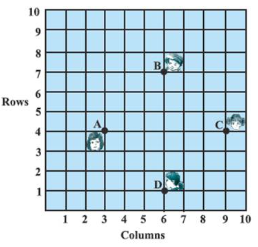
Key Idea
Use the distance formula \(d = \sqrt{(x_2-x_1)^2+(y_2-y_1)^2}\) to compute the lengths of all four sides of quadrilateral \(ABCD\). If all four sides are equal (and the diagonals are equal), the figure is a square; otherwise it is not.
Step-by-Step Solution
1. Read the coordinates from Fig. 7.8 (as given in the textbook):
\[A(2,3),\; B(6,3),\; C(6,5),\; D(2,5)\]
2. Compute the length of side \(AB\):
\[AB = \sqrt{(6-2)^2 + (3-3)^2} = \sqrt{4^2 + 0^2} = \sqrt{16} = 4\]
3. Compute the length of side \(BC\):
\[BC = \sqrt{(6-6)^2 + (5-3)^2} = \sqrt{0^2 + 2^2} = \sqrt{4} = 2\]
4. Compute the length of side \(CD\):
\[CD = \sqrt{(2-6)^2 + (5-5)^2} = \sqrt{(-4)^2 + 0^2} = \sqrt{16} = 4\]
5. Compute the length of side \(DA\):
\[DA = \sqrt{(2-2)^2 + (3-5)^2} = \sqrt{0^2 + (-2)^2} = \sqrt{4} = 2\]
6. Compare the side lengths:
- Opposite sides are equal (\(AB = CD = 4\) and \(BC = DA = 2\)).
- Adjacent sides are not equal (\(AB
eq BC\)).
7. Conclusion: Since a square requires all four sides to be equal, \(ABCD\) is not a square; it is a rectangle. Therefore Chameli’s statement is correct.
*(If required, one may also compute the diagonals \(AC\) and \(BD\) to confirm that they are equal, which is a property of a rectangle but not needed to settle the square‑vs‑rectangle question.)
\[A(2,3),\; B(6,3),\; C(6,5),\; D(2,5)\]
2. Compute the length of side \(AB\):
\[AB = \sqrt{(6-2)^2 + (3-3)^2} = \sqrt{4^2 + 0^2} = \sqrt{16} = 4\]
3. Compute the length of side \(BC\):
\[BC = \sqrt{(6-6)^2 + (5-3)^2} = \sqrt{0^2 + 2^2} = \sqrt{4} = 2\]
4. Compute the length of side \(CD\):
\[CD = \sqrt{(2-6)^2 + (5-5)^2} = \sqrt{(-4)^2 + 0^2} = \sqrt{16} = 4\]
5. Compute the length of side \(DA\):
\[DA = \sqrt{(2-2)^2 + (3-5)^2} = \sqrt{0^2 + (-2)^2} = \sqrt{4} = 2\]
6. Compare the side lengths:
- Opposite sides are equal (\(AB = CD = 4\) and \(BC = DA = 2\)).
- Adjacent sides are not equal (\(AB
eq BC\)).
7. Conclusion: Since a square requires all four sides to be equal, \(ABCD\) is not a square; it is a rectangle. Therefore Chameli’s statement is correct.
*(If required, one may also compute the diagonals \(AC\) and \(BD\) to confirm that they are equal, which is a property of a rectangle but not needed to settle the square‑vs‑rectangle question.)
Question 6
Hint available
Name the type of quadrilateral formed, if any, by the following points, and give reasons for your answer: (i) (– 1, – 2), (1, 0), (– 1, 2), (– 3, 0) (ii) (–3, 5), (3, 1), (0, 3), (–1, – 4) (iii) (4, 5), (7, 6), (4, 3), (1, 2)
Key Idea
Use the distance formula \(d=\sqrt{(x_2-x_1)^2+(y_2-y_1)^2}\) to find side lengths and the slope formula \(m=\frac{y_2-y_1}{x_2-x_1}\) to test parallelism (equal slopes) and perpendicularity (product of slopes = –1). A quadrilateral is a square if all sides are equal and adjacent sides are perpendicular; a rectangle if opposite sides are parallel and adjacent sides are perpendicular; a rhombus if all sides are equal; a parallelogram if opposite sides are parallel (and equal). If any three points are collinear, a quadrilateral cannot be formed.
Step-by-Step Solution
### Part (i) : Points A(–1, –2), B(1, 0), C(–1, 2), D(–3, 0)
1. Side lengths
- \(AB = \sqrt{(1+1)^2+(0+2)^2}=\sqrt{4+4}=2\sqrt2\)
- \(BC = \sqrt{(-1-1)^2+(2-0)^2}=2\sqrt2\)
- \(CD = \sqrt{(-3+1)^2+(0-2)^2}=2\sqrt2\)
- \(DA = \sqrt{(-1+3)^2+(-2-0)^2}=2\sqrt2\)
All four sides are equal.
2. Slopes of sides
- \(m_{AB}=\frac{0-(-2)}{1-(-1)}=1\)
- \(m_{BC}=\frac{2-0}{-1-1}=-1\)
- \(m_{CD}=\frac{0-2}{-3-(-1)}=1\)
- \(m_{DA}=\frac{-2-0}{-1-(-3)}=-1\)
Opposite sides have equal slopes (AB // CD and BC // DA).
3. Perpendicularity
- \(m_{AB}\times m_{BC}=1\times(-1)=-1\) → adjacent sides are perpendicular.
4. Diagonals
- \(AC = \sqrt{(-1+1)^2+(2+2)^2}=4\)
- \(BD = \sqrt{(1+3)^2+(0-0)^2}=4\)
Diagonals are equal and perpendicular (slopes undefined and 0).
Conclusion: All sides equal, opposite sides parallel, adjacent sides perpendicular ⇒ the quadrilateral is a square.
### Part (ii) : Points A(–3, 5), B(3, 1), C(0, 3), D(–1, –4)
1. Check collinearity of A, B, C
- Slope \(AB = \frac{1-5}{3-(-3)} = -\frac{4}{6}= -\frac{2}{3}\)
- Slope \(BC = \frac{3-1}{0-3}= \frac{2}{-3}= -\frac{2}{3}\)
Since \(m_{AB}=m_{BC}\), points A, B, C lie on the same straight line.
2. Because three of the given points are collinear, they cannot form a closed four‑sided figure.
Conclusion: No quadrilateral is formed (the points are collinear).
### Part (iii) : Points A(4, 5), B(7, 6), C(4, 3), D(1, 2)
1. Slopes
- \(m_{AB}=\frac{6-5}{7-4}=\frac{1}{3}\)
- \(m_{BC}=\frac{3-6}{4-7}=\frac{-3}{-3}=1\)
- \(m_{CD}=\frac{2-3}{1-4}=\frac{-1}{-3}=\frac{1}{3}\)
- \(m_{DA}=\frac{5-2}{4-1}=\frac{3}{3}=1\)
Hence AB // CD (both slope \(\frac13\)) and BC // DA (both slope \(1\)).
2. Side lengths
- \(AB = \sqrt{(7-4)^2+(6-5)^2}=\sqrt{9+1}=\sqrt{10}\)
- \(BC = \sqrt{(4-7)^2+(3-6)^2}=\sqrt{9+9}=\sqrt{18}=3\sqrt2\)
- \(CD = \sqrt{(1-4)^2+(2-3)^2}=\sqrt{9+1}=\sqrt{10}\)
- \(DA = \sqrt{(4-1)^2+(5-2)^2}=\sqrt{9+9}=\sqrt{18}=3\sqrt2\)
Opposite sides are equal.
3. Angles
- Product of adjacent slopes \(m_{AB}\times m_{BC}=\frac13\times1=\frac13
eq-1\); therefore adjacent sides are not perpendicular.
Conclusion: Opposite sides are parallel and equal, but adjacent sides are not perpendicular ⇒ the quadrilateral is a parallelogram (not a rectangle or rhombus).
Overall Answers
- (i) Square
- (ii) No quadrilateral (three points are collinear)
- (iii) Parallelogram
1. Side lengths
- \(AB = \sqrt{(1+1)^2+(0+2)^2}=\sqrt{4+4}=2\sqrt2\)
- \(BC = \sqrt{(-1-1)^2+(2-0)^2}=2\sqrt2\)
- \(CD = \sqrt{(-3+1)^2+(0-2)^2}=2\sqrt2\)
- \(DA = \sqrt{(-1+3)^2+(-2-0)^2}=2\sqrt2\)
All four sides are equal.
2. Slopes of sides
- \(m_{AB}=\frac{0-(-2)}{1-(-1)}=1\)
- \(m_{BC}=\frac{2-0}{-1-1}=-1\)
- \(m_{CD}=\frac{0-2}{-3-(-1)}=1\)
- \(m_{DA}=\frac{-2-0}{-1-(-3)}=-1\)
Opposite sides have equal slopes (AB // CD and BC // DA).
3. Perpendicularity
- \(m_{AB}\times m_{BC}=1\times(-1)=-1\) → adjacent sides are perpendicular.
4. Diagonals
- \(AC = \sqrt{(-1+1)^2+(2+2)^2}=4\)
- \(BD = \sqrt{(1+3)^2+(0-0)^2}=4\)
Diagonals are equal and perpendicular (slopes undefined and 0).
Conclusion: All sides equal, opposite sides parallel, adjacent sides perpendicular ⇒ the quadrilateral is a square.
### Part (ii) : Points A(–3, 5), B(3, 1), C(0, 3), D(–1, –4)
1. Check collinearity of A, B, C
- Slope \(AB = \frac{1-5}{3-(-3)} = -\frac{4}{6}= -\frac{2}{3}\)
- Slope \(BC = \frac{3-1}{0-3}= \frac{2}{-3}= -\frac{2}{3}\)
Since \(m_{AB}=m_{BC}\), points A, B, C lie on the same straight line.
2. Because three of the given points are collinear, they cannot form a closed four‑sided figure.
Conclusion: No quadrilateral is formed (the points are collinear).
### Part (iii) : Points A(4, 5), B(7, 6), C(4, 3), D(1, 2)
1. Slopes
- \(m_{AB}=\frac{6-5}{7-4}=\frac{1}{3}\)
- \(m_{BC}=\frac{3-6}{4-7}=\frac{-3}{-3}=1\)
- \(m_{CD}=\frac{2-3}{1-4}=\frac{-1}{-3}=\frac{1}{3}\)
- \(m_{DA}=\frac{5-2}{4-1}=\frac{3}{3}=1\)
Hence AB // CD (both slope \(\frac13\)) and BC // DA (both slope \(1\)).
2. Side lengths
- \(AB = \sqrt{(7-4)^2+(6-5)^2}=\sqrt{9+1}=\sqrt{10}\)
- \(BC = \sqrt{(4-7)^2+(3-6)^2}=\sqrt{9+9}=\sqrt{18}=3\sqrt2\)
- \(CD = \sqrt{(1-4)^2+(2-3)^2}=\sqrt{9+1}=\sqrt{10}\)
- \(DA = \sqrt{(4-1)^2+(5-2)^2}=\sqrt{9+9}=\sqrt{18}=3\sqrt2\)
Opposite sides are equal.
3. Angles
- Product of adjacent slopes \(m_{AB}\times m_{BC}=\frac13\times1=\frac13
eq-1\); therefore adjacent sides are not perpendicular.
Conclusion: Opposite sides are parallel and equal, but adjacent sides are not perpendicular ⇒ the quadrilateral is a parallelogram (not a rectangle or rhombus).
Overall Answers
- (i) Square
- (ii) No quadrilateral (three points are collinear)
- (iii) Parallelogram
Question 7
Hint available
Find the point on the x-axis which is equidistant from (2, –5) and (–2, 9).
Key Idea
Use the distance formula to express the distances from a generic point on the x‑axis to the two given points, set the distances equal (since the point is equidistant), and solve the resulting equation for the x‑coordinate.
Step-by-Step Solution
1. Let the required point on the x‑axis be \((x,0)\).
2. Distance from \((x,0)\) to \((2,-5)\):
$$d_1 = \sqrt{(x-2)^2 + (0+5)^2} = \sqrt{(x-2)^2 + 25}.$$
3. Distance from \((x,0)\) to \((-2,9)\):
$$d_2 = \sqrt{(x+2)^2 + (0-9)^2} = \sqrt{(x+2)^2 + 81}.$$
4. Since the point is equidistant, set \(d_1 = d_2\) and square both sides to remove the square roots:
$$(x-2)^2 + 25 = (x+2)^2 + 81.$$
5. Expand the squares:
\[x^2 - 4x + 4 + 25 = x^2 + 4x + 4 + 81.\]
6. Cancel \(x^2\) and simplify:
\[-4x + 29 = 4x + 85.\]
7. Bring like terms together:
\[-4x - 4x = 85 - 29 \quad\Rightarrow\quad -8x = 56.\]
8. Solve for \(x\):
$$x = \frac{-56}{8} = -7.$$
9. Therefore the required point on the x‑axis is \((-7,0)\).
2. Distance from \((x,0)\) to \((2,-5)\):
$$d_1 = \sqrt{(x-2)^2 + (0+5)^2} = \sqrt{(x-2)^2 + 25}.$$
3. Distance from \((x,0)\) to \((-2,9)\):
$$d_2 = \sqrt{(x+2)^2 + (0-9)^2} = \sqrt{(x+2)^2 + 81}.$$
4. Since the point is equidistant, set \(d_1 = d_2\) and square both sides to remove the square roots:
$$(x-2)^2 + 25 = (x+2)^2 + 81.$$
5. Expand the squares:
\[x^2 - 4x + 4 + 25 = x^2 + 4x + 4 + 81.\]
6. Cancel \(x^2\) and simplify:
\[-4x + 29 = 4x + 85.\]
7. Bring like terms together:
\[-4x - 4x = 85 - 29 \quad\Rightarrow\quad -8x = 56.\]
8. Solve for \(x\):
$$x = \frac{-56}{8} = -7.$$
9. Therefore the required point on the x‑axis is \((-7,0)\).
Question 8
Hint available
Find the values of y for which the distance between the points P(2, – 3) and Q(10, y) is 10 units. 106
Key Idea
Use the distance formula between two points \((x_1,y_1)\) and \((x_2,y_2)\): \[ d = \sqrt{(x_2-x_1)^2 + (y_2-y_1)^2}.\] Set the distance equal to 10 and solve the resulting quadratic equation for \(y\).
Step-by-Step Solution
1. Write down the coordinates of the two points:
\[ P(2, -3) \quad \text{and} \quad Q(10, y). \]
2. Apply the distance formula:
\[ \sqrt{(10-2)^2 + (y-(-3))^2} = 10. \]
3. Simplify inside the square root:
\[ \sqrt{8^2 + (y+3)^2} = 10 \]
\[ \sqrt{64 + (y+3)^2} = 10. \]
4. Square both sides to remove the square root (both sides are non‑negative):
\[ 64 + (y+3)^2 = 100. \]
5. Isolate the quadratic term:
\[ (y+3)^2 = 100 - 64 = 36. \]
6. Take square roots (remember both positive and negative roots):
\[ y+3 = \pm 6. \]
7. Solve for \(y\):
- If \(y+3 = 6\), then \(y = 6 - 3 = 3\).
- If \(y+3 = -6\), then \(y = -6 - 3 = -9\).
8. Hence the required values of \(y\) are \(y = 3\) and \(y = -9\).
\[ P(2, -3) \quad \text{and} \quad Q(10, y). \]
2. Apply the distance formula:
\[ \sqrt{(10-2)^2 + (y-(-3))^2} = 10. \]
3. Simplify inside the square root:
\[ \sqrt{8^2 + (y+3)^2} = 10 \]
\[ \sqrt{64 + (y+3)^2} = 10. \]
4. Square both sides to remove the square root (both sides are non‑negative):
\[ 64 + (y+3)^2 = 100. \]
5. Isolate the quadratic term:
\[ (y+3)^2 = 100 - 64 = 36. \]
6. Take square roots (remember both positive and negative roots):
\[ y+3 = \pm 6. \]
7. Solve for \(y\):
- If \(y+3 = 6\), then \(y = 6 - 3 = 3\).
- If \(y+3 = -6\), then \(y = -6 - 3 = -9\).
8. Hence the required values of \(y\) are \(y = 3\) and \(y = -9\).
Question 9
Hint available
If Q(0, 1) is equidistant from P(5, –3) and R(x, 6), find the values of x. Also find the distances QR and PR.
Key Idea
Use the distance formula \(d = \sqrt{(x_2-x_1)^2+(y_2-y_1)^2}\). Since Q is equidistant from P and R, set \(QP = QR\) and solve for \(x\). Then compute the required distances using the same formula.
Step-by-Step Solution
1. Write the distance QP using the distance formula:
$$QP = \sqrt{(5-0)^2+(-3-1)^2}=\sqrt{5^2+(-4)^2}=\sqrt{25+16}=\sqrt{41}.$$
2. Express QR in terms of the unknown \(x\):
$$QR = \sqrt{(x-0)^2+(6-1)^2}=\sqrt{x^2+5^2}=\sqrt{x^2+25}.$$
3. Equate the two distances because Q is equidistant from P and R:
$$\sqrt{x^2+25}=\sqrt{41}\;\Rightarrow\;x^2+25=41\;\Rightarrow\;x^2=16.$$
4. Solve for \(x\):
$$x = \pm 4.$$
5. Find QR (which equals QP):
$$QR = \sqrt{41} \;\text{units}.$$
6. Find PR for each value of \(x\):
- For \(x = 4\):
$$PR = \sqrt{(4-5)^2+(6-(-3))^2}=\sqrt{(-1)^2+9^2}=\sqrt{1+81}=\sqrt{82}.$$
- For \(x = -4\):
$$PR = \sqrt{(-4-5)^2+(6-(-3))^2}=\sqrt{(-9)^2+9^2}=\sqrt{81+81}=\sqrt{162}=9\sqrt{2}.$$
$$QP = \sqrt{(5-0)^2+(-3-1)^2}=\sqrt{5^2+(-4)^2}=\sqrt{25+16}=\sqrt{41}.$$
2. Express QR in terms of the unknown \(x\):
$$QR = \sqrt{(x-0)^2+(6-1)^2}=\sqrt{x^2+5^2}=\sqrt{x^2+25}.$$
3. Equate the two distances because Q is equidistant from P and R:
$$\sqrt{x^2+25}=\sqrt{41}\;\Rightarrow\;x^2+25=41\;\Rightarrow\;x^2=16.$$
4. Solve for \(x\):
$$x = \pm 4.$$
5. Find QR (which equals QP):
$$QR = \sqrt{41} \;\text{units}.$$
6. Find PR for each value of \(x\):
- For \(x = 4\):
$$PR = \sqrt{(4-5)^2+(6-(-3))^2}=\sqrt{(-1)^2+9^2}=\sqrt{1+81}=\sqrt{82}.$$
- For \(x = -4\):
$$PR = \sqrt{(-4-5)^2+(6-(-3))^2}=\sqrt{(-9)^2+9^2}=\sqrt{81+81}=\sqrt{162}=9\sqrt{2}.$$
Question 10
Hint available
Find a relation between x and y such that the point (x, y) is equidistant from the point (3, 6) and (– 3, 4).
Key Idea
Use the distance formula to set the distances from (x, y) to the two given points equal. Squaring eliminates the square‑roots and yields a linear equation, which is the required relation between x and y. This relation represents the perpendicular bisector of the line segment joining the two fixed points.
Step-by-Step Solution
1. Write the distances using the distance formula
\[
\text{Distance to }(3,6) = \sqrt{(x-3)^2+(y-6)^2},\qquad
\text{Distance to }(-3,4) = \sqrt{(x+3)^2+(y-4)^2}.
\]
2. Equate the two distances (since the point is equidistant):
\[
\sqrt{(x-3)^2+(y-6)^2}=\sqrt{(x+3)^2+(y-4)^2}.
\]
3. Square both sides to remove the square‑roots:
\[
(x-3)^2+(y-6)^2=(x+3)^2+(y-4)^2.
\]
4. Expand each side
\[
\begin{aligned}
\text{Left side}&: (x^2-6x+9)+(y^2-12y+36) \
&= x^2+y^2-6x-12y+45,\\[4pt]
\text{Right side}&: (x^2+6x+9)+(y^2-8y+16) \
&= x^2+y^2+6x-8y+25.
\end{aligned}
\]
5. Cancel the common terms $x^2$ and $y^2$ and bring all terms to one side:
\[
-6x-12y+45 = 6x-8y+25 \quad\Rightarrow\quad -6x-12y+45-6x+8y-25 =0.
\]
6. Simplify
\[
-12x-4y+20 =0 \quad\Rightarrow\quad 12x+4y-20 =0.
\]
7. Divide by 4 to obtain the simplest linear relation:
\[
3x + y - 5 = 0 \quad\text{or}\quad y = 5-3x.
\]
Thus the required relation between $x$ and $y$ is $3x + y = 5$.
\[
\text{Distance to }(3,6) = \sqrt{(x-3)^2+(y-6)^2},\qquad
\text{Distance to }(-3,4) = \sqrt{(x+3)^2+(y-4)^2}.
\]
2. Equate the two distances (since the point is equidistant):
\[
\sqrt{(x-3)^2+(y-6)^2}=\sqrt{(x+3)^2+(y-4)^2}.
\]
3. Square both sides to remove the square‑roots:
\[
(x-3)^2+(y-6)^2=(x+3)^2+(y-4)^2.
\]
4. Expand each side
\[
\begin{aligned}
\text{Left side}&: (x^2-6x+9)+(y^2-12y+36) \
&= x^2+y^2-6x-12y+45,\\[4pt]
\text{Right side}&: (x^2+6x+9)+(y^2-8y+16) \
&= x^2+y^2+6x-8y+25.
\end{aligned}
\]
5. Cancel the common terms $x^2$ and $y^2$ and bring all terms to one side:
\[
-6x-12y+45 = 6x-8y+25 \quad\Rightarrow\quad -6x-12y+45-6x+8y-25 =0.
\]
6. Simplify
\[
-12x-4y+20 =0 \quad\Rightarrow\quad 12x+4y-20 =0.
\]
7. Divide by 4 to obtain the simplest linear relation:
\[
3x + y - 5 = 0 \quad\text{or}\quad y = 5-3x.
\]
Thus the required relation between $x$ and $y$ is $3x + y = 5$.